PSTN Switch Off
Happening 31st January, 2027


Gear up for the impending PSTN switch off!
The UK is retiring the legacy copper phone network — and the PSTN switch-off is due by the end of January 2027. If your business still relies on analogue lines, ISDN, or older copper-based broadband, now is the time to move to an all-IP solution delivered over fibre or modern connectivity.
This isn’t just a phone-system change. It impacts anything that “dials out” — from alarm lines and EPOS terminals to door entry, lift lines and legacy failover circuits. Unified World helps IT Managers and Business Directors plan, migrate and support the move with minimal disruption and a clear commercial roadmap.
What is the PSTN Switch Off?
The PSTN switch off is the withdrawal of the UK’s traditional copper-based phone network — the infrastructure that has carried voice calls for decades. It’s being replaced by digital voice delivered over Internet Protocol (IP), typically running over full fibre, Ethernet, or other modern connectivity.
For businesses, this means legacy services such as analogue lines, ISDN and WLR-based voice services will be retired, and older connectivity types that depend heavily on copper will continue to decline. The practical outcome is simple: if your organisation still uses copper voice services (or devices that depend on them), they must be migrated ahead of the deadline.
From 5 September 2023, the industry introduced “stop sell” rules in many areas — limiting new sales of certain legacy copper services and accelerating the move to fibre and IP solutions.
The 2027 deadline is real — and it’s closer than it looks
The PSTN retirement isn’t a vague “sometime in the future” event — the UK’s legacy PSTN is scheduled to be retired by January 2027, and organisations still using PSTN-reliant services will need to be fully migrated before then.
For IT teams, the risk isn’t just replacing desk phones. It’s the long tail of services that quietly depend on copper dial tone and only get noticed when they fail — or when you try to port numbers or migrate a site under time pressure.
For Business Directors, the risk is operational: delays can force rushed decisions, missed resilience requirements, and avoidable cost increases as legacy services become more expensive to keep running.
Unified World can help you build a controlled migration plan now — so you stay in control of timelines, budget, and business continuity.
PSTN Switch Off and the Now of Voice Services
Leave your details below and Download our White Paper
Why is the Switch Off happening?
The PSTN is built on ageing copper infrastructure that’s increasingly expensive to maintain and more prone to faults. Meanwhile, business communications have moved on: modern organisations need flexible working, mobile integration, cloud collaboration, and resilient connectivity that supports voice, video and data — not just dial tone.
The national direction is clear: investment is going into fibre and IP services, not copper. In parallel, the regulator’s Telecoms Access Review 2026–31 sets the framework for UK fixed telecoms markets from April 2026 — reinforcing the shift toward next-generation networks and away from legacy infrastructure.

When is the Switch Off happening?
The PSTN is due to be switched off by the end of January 2027. Any service still dependent on the legacy network after that point risks loss of service.
Importantly, you may be forced to change earlier than 2027 depending on your exchange area, supplier plans, and fibre availability. That’s why businesses should treat this as an IT roadmap item — not something to leave until the final months.
Stay Connected Anywhere, Anytime
With modern hosted voice or Teams-integrated calling, your users can make and receive calls anywhere — office, home, or mobile — with the same number, the same features, and central control for IT.
Enhanced Flexibility and Cost-Efficiency
Moving to VoIP and fibre enables modern call handling, easier scaling, simpler site moves, and better business continuity — often with lower total cost than maintaining multiple copper lines.
Comprehensive Feature Set
From auto-attendants and hunt groups to call recording, reporting, CRM integration and mobile/desktop apps — modern IP telephony gives you the tools to improve customer experience and operational performance.
Why “do nothing” will cost more
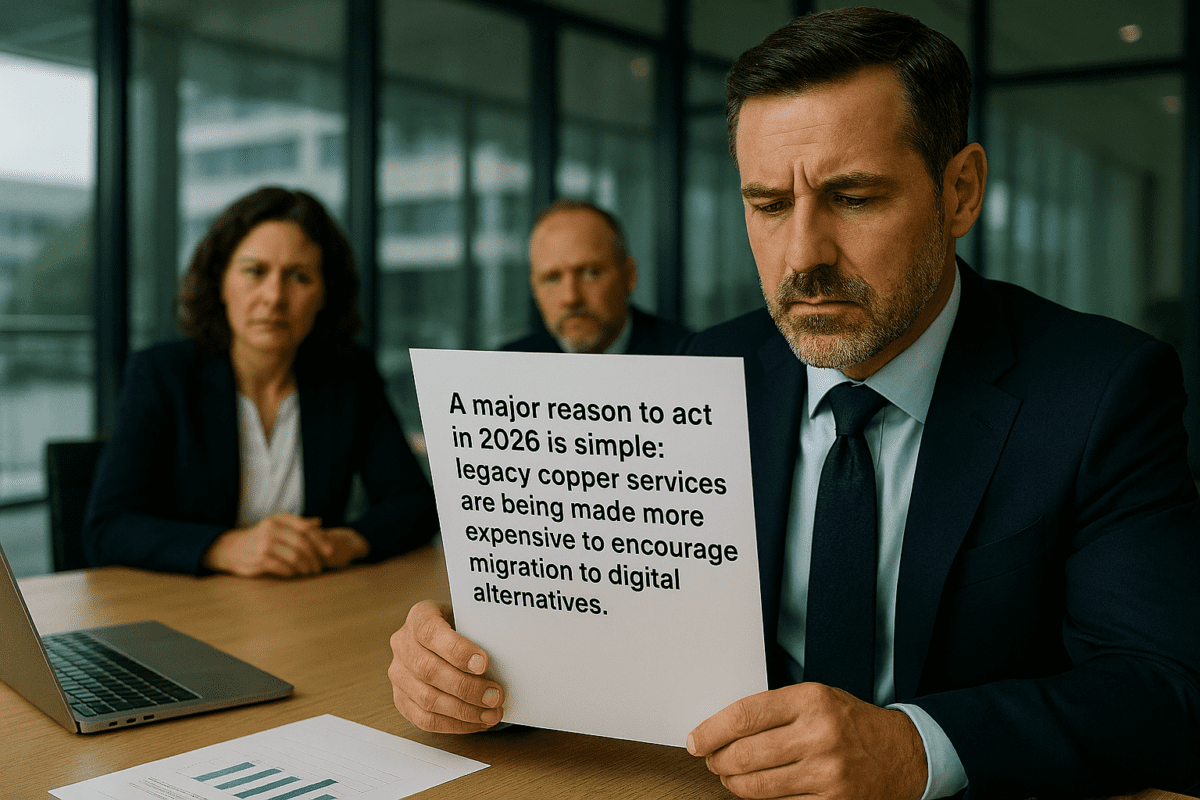
A major reason to act in 2026 is simple: legacy copper services are being made more expensive to encourage migration to digital alternatives.
Openreach has announced staged wholesale rental increases for WLR (Wholesale Line Rental) products during 2026, including:
-
1 April 2026: +20%
-
1 July 2026: further uplift
-
1 October 2026: further uplift — with the published intention that basic WLR rental effectively doubles versus the prior baseline by that point.
In practice, many providers and channels pass these wholesale rises through to customers on legacy lines. That means your cost base for copper voice can increase sharply even before the January 2027 withdrawal.
If you’re still running multiple analogue lines across sites (including “quiet” lines for alarms and entry systems), the fastest ROI move is often:
-
identify which lines are genuinely needed,
-
replace PSTN dependencies, and
-
migrate voice to an IP solution with the right resilience.
Stay Connected Anywhere, Anytime
A modern business phone system ensures constant connectivity. Regardless of your team’s location—whether in the office, working remotely, or on the move—you can effortlessly make calls, establish connections, and foster collaboration. The full suite of phone system tools and features are readily accessible at your fingertips, allowing seamless communication no matter where your business operations take you.
Enhanced Flexibility and Cost-Efficiency
Embracing Voice over Internet Protocol (VoIP) technology through the PSTN switch off introduces a realm of advantages. VoIP operates over the internet, enabling you to make free or highly cost-effective calls. This transition also grants your business a newfound flexibility. You can manage calls from various devices and locations, ensuring that you remain responsive at all times. The result? Uninterrupted communication and the capacity to attend to calls regardless of your whereabouts, ensuring that important calls are never missed.
Comprehensive Feature Set
Embracing a modern business phone system offers access to a wide array of communication tools. The versatility of call features is virtually limitless. From proficient call management options like call handling, voicemail-to-email functionality, collaborative call distribution, and automated attendants to dynamic features such as live call boards, real-time analytics, and call recording, the possibilities are expansive. This system can be tailored to align precisely with the specific needs of your business, amplifying its operational efficiency.
How will it affect my business?
If you still run analogue lines, ISDN, WLR voice lines, or have devices that depend on a PSTN line, you will need a migration plan before the January 2027 deadline.
What catches businesses out is not the handsets — it’s the hidden dependencies:
-
alarm signalling and monitored lines
-
EPOS / payment terminals (in some setups)
-
door entry and intercoms
-
lift emergency lines
-
legacy failover and “red care” style circuits
-
on-site PBX systems still tied to ISDN or analogue trunks
Unified World helps you identify what’s connected, what’s critical, and what must change first.
.
What should I do?
If your business still depends on PSTN/WLR/ISDN, or any device that relies on those lines, it must be migrated to IP before the January 2027 deadline.
Unified World can handle the full journey: audit → design → connectivity upgrade → voice migration → device remediation → resilience → ongoing support — so IT stays in control and the business stays connected.
Why not have a look at our own VoIP Phone System, Talk Express

What IT should audit (the hidden PSTN dependency checklist)
Most PSTN projects go wrong for one reason: organisations only assess “phones”, not everything that uses a phone line.
Here are the common PSTN dependencies we find in business estates:
-
Alarm signalling (monitored systems, legacy diallers)
-
Lift emergency lines
-
Fire / building management panels
-
Door entry / intercoms / gate systems
-
EPOS / payment terminals (in some deployments)
-
Fax and franking lines (still surprisingly common)
-
Legacy PBX trunks (ISDN2/ISDN30, analogue trunks)
-
Out-of-hours / failover lines that no one “owns” day-to-day
Unified World’s audit maps: what the line is, what it supports, who owns it, what the replacement path is, and what the cutover plan looks like.
Power and resilience — answering the #1 VoIP concern
With PSTN, your line carried power. With digital voice, calls run over your network — which means local power and connectivity resilience become part of the design.
For IT Managers, this is an opportunity to do it properly:
-
UPS coverage for comms cabinets, routers and switches (where required)
-
Dual connectivity (fibre + backup) for critical sites
-
4G/5G failover for continuity during outages
-
Call failover rules (auto-divert, mobile twinning, overflow routing)
Unified World designs voice like an availability service: we match resilience to business impact, so you’re not over-spending — but you’re also not leaving reception, customer service or on-call teams exposed.
Get in Touch
We’d be happy to assist with your requirements
T: 01254 271 334
E: sales@unifiedworld.co.uk
Yes — many businesses phase by site, department, or service type (voice first, then analogue devices), reducing risk and spreading cost.
Not always, but you do need stable connectivity. We’ll check bandwidth, latency, and resilience and recommend upgrades or backup where needed.
We can audit services, design the target solution, manage connectivity and voice changes, coordinate porting, implement resilience, and support you post-migration.
Check invoices and site comms rooms, and review “small” lines that support lifts/alarms/entry systems. We can help identify and map what’s live.
It varies. A straightforward hosted voice migration can be quick, but uncovering and replacing multiple analogue devices across sites can take longer. We’ll plan it.
Traditional lines often carried power; VoIP typically needs power and internet. We can design battery backup/UPS, resilience, and call failover options.
It’s the retirement of traditional analogue phone services in favour of IP-based services. Businesses need to move voice and any dependent devices to digital alternatives.
Phone lines/ISDN, and any devices relying on analogue lines: alarms, EPOS terminals, lift lines, door entry, fax, PDQ, and some legacy broadband types.
Usually hosted VoIP/cloud telephony, SIP, and/or suitable IP/4G alternatives for specialised devices — chosen based on resilience, compliance, and cost.
Some will need upgrading or an IP/cellular replacement. We’ll help assess each device and recommend a compliant migration route.

Why Companies Should Ditch the Desk Phone and Use Applications for Phone Services
Why Companies Should Ditch the Desk Phone and Use Applications for Phone Services

Embracing the Great PSTN Switch-off: A Guide for Company Directors
Embracing the Great PSTN Switch-off: A Guide for Company Directors

Improving Caller Experience: Choosing the Right Voices and Music
Improving Caller Experience: Choosing the Right Voices and Music

How Your Phone System Can Improve Customer Experience